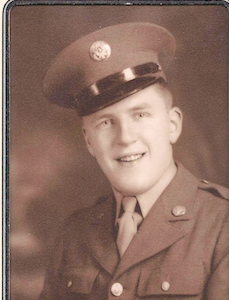
The Story of Melvin J. Schenck | An American Hero

This blog post is written in response to Amy Johnson Crow’s invitation to participate in the 2026 52 Ancestors in 52 Weeks Challenge. Prompt for Week 3: What This Story Means to Me


The Early Years
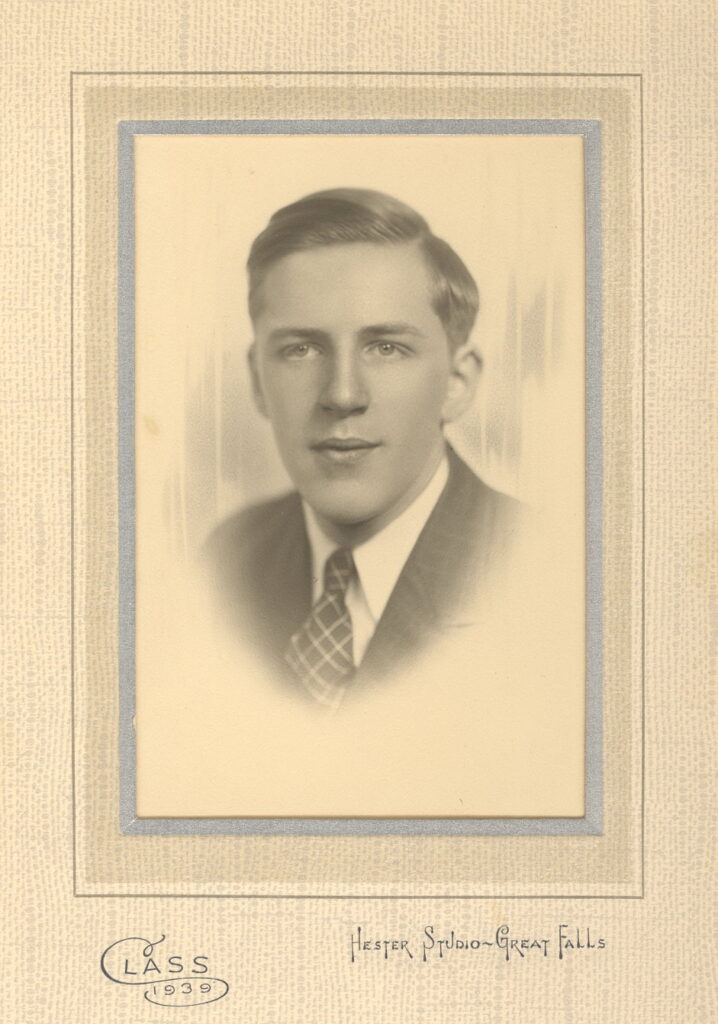
Melvin J. Schenck entered the world on September 11, 1921, in Neihart, a small mining town in Montana-a place shaped by hard work, deep winters, and close-knit families who depended on one another. His own family reflected an American story carried west by immigrants seeking opportunity. His father, born in Michigan in 1879, was the son of Swiss German parents who had crossed an ocean in pursuit of something better. His mother, born in Minnesota in 1887, descended from first-generation Scandinavian parents whose culture and quiet resilience shaped their household.

Melvin was the ninth of eleven children, though the family bore the sorrow of three sons lost before his birth. Even with that grief woven into their history, the Schenck home was full – full of voices, responsibilities, and the daily rhythm of life in a large family learning to make do. When Melvin was five, the family moved to Great Falls, a growing industrial city roughly an hour from Neihart. For eight years, he adjusted to new routines, new classrooms, and a different pace of life. But at thirteen, they returned to Neihart, back to the mountains where he had taken his first steps. That return, to familiar peaks in a smaller community, helped define his teenage years.

As a student, Melvin gravitated toward numbers. Mathematics was his favorite subject, a steady language that made sense to him. Outside the classroom, he read constantly – books offering a world beyond Montana, even though he himself had never traveled outside the state. Shakespeare fascinated him, and he read the plays not only because they were assigned but because he enjoyed them. The Comedy of Errors was his favorite, a story of confusion and misdirection that he found both clever and amusing.

When he reflected on his life as a senior in high school, he wrote plainly of his hopes. He wished to attend college, dreaming of becoming an engineer. It was a goal-shaped by talent and ambition, and an earnest desire to build something lasting. his path forward seemed clear, grounded and discipline, curiosity, and the momentum of a young man looking toward adulthood. 

A few quotes from Melvin’s autobiography written during his senior year of high school . . .

“During my life, I have done little traveling; I was never out of the state of Montana. This summer, however, my brother and I spent one week with our brother, Donald, in Shelby and we were able to visit Cut Bank, Sweetgrass and other cities around that country.”

“When I finish high school, I certainly hope I’ll be able to go to college. If I can’t go immediately after I graduate I may get a chance later. As for my life work I would like to take up engineering or else become a mathematician.”

“My favorite amusement is reading … I especially like O. Henry’s short stories … and mystery novels …”

Enlistment and Training

Everything shifted after the attack on Pearl Harbor. Like many young Americans, Melvin answered the call to serve. On February 16, 1942, he enlisted in the U.S. Army. At the time, he was working for the Crane Company at the Great Falls railroad yards, a job tied to the city’s industrial heartbeat. Military service promised change, challenge, and a sense of purpose larger than his own plans.
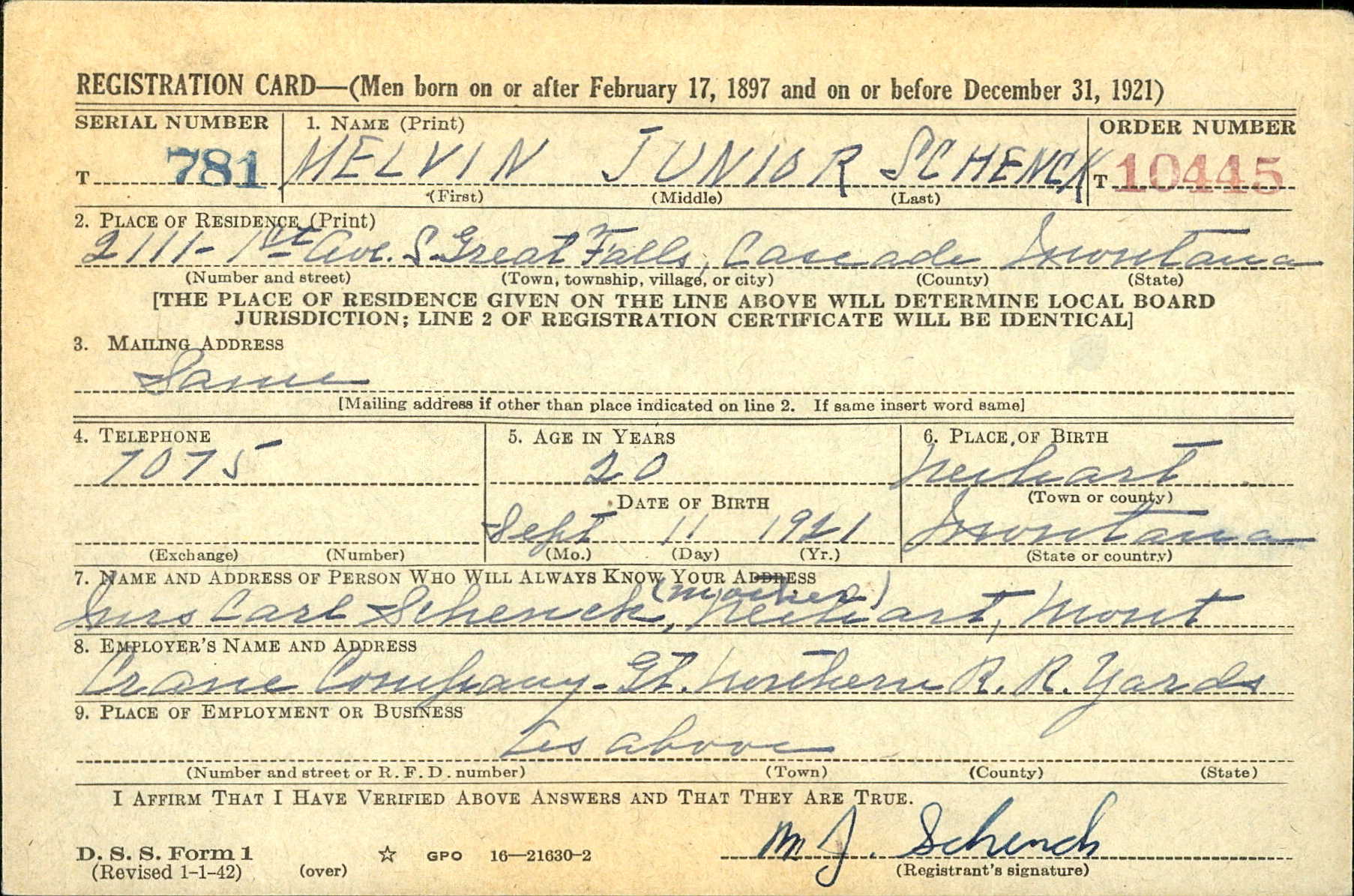
Melvin’s WWII Registration Card

His physical description, recorded on the Registrar’s Report, captured a young man still standing at the threshold of life – 5 feet 10 inches tall, weighing 140 pounds, with a light complexion, blue eyes, and brown hair.
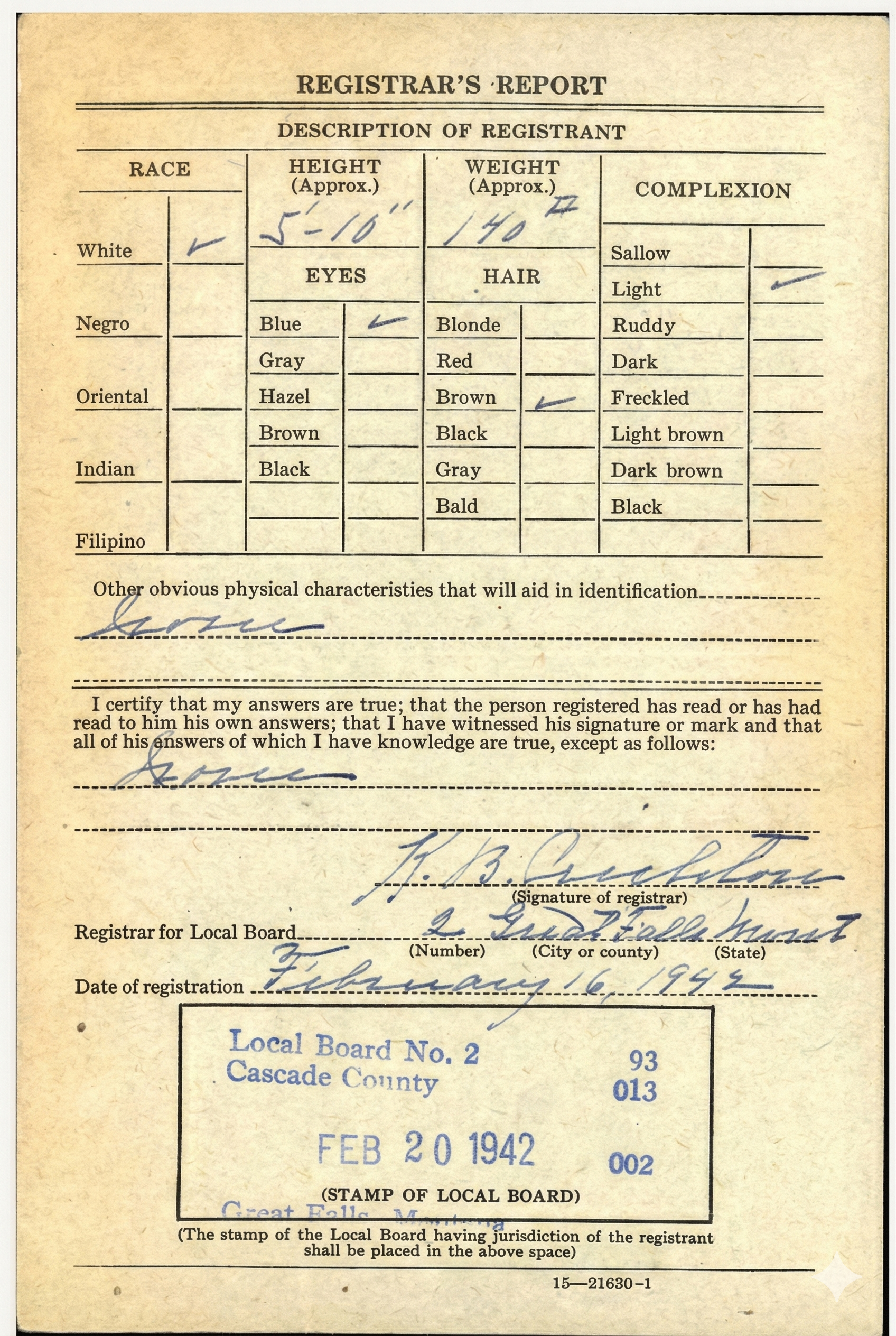
Registrar’s Report

Training took him far from Montana, first to Camp Bartley and then Camp Maxey in Texas. The scale, speed, and intensity of army life transformed him. For one year he was an Army student at the University of Arkansas, furthering his studies and the uncertainties of wartime. Though his path toward engineering had been interrupted, his dedication to learning never faded.
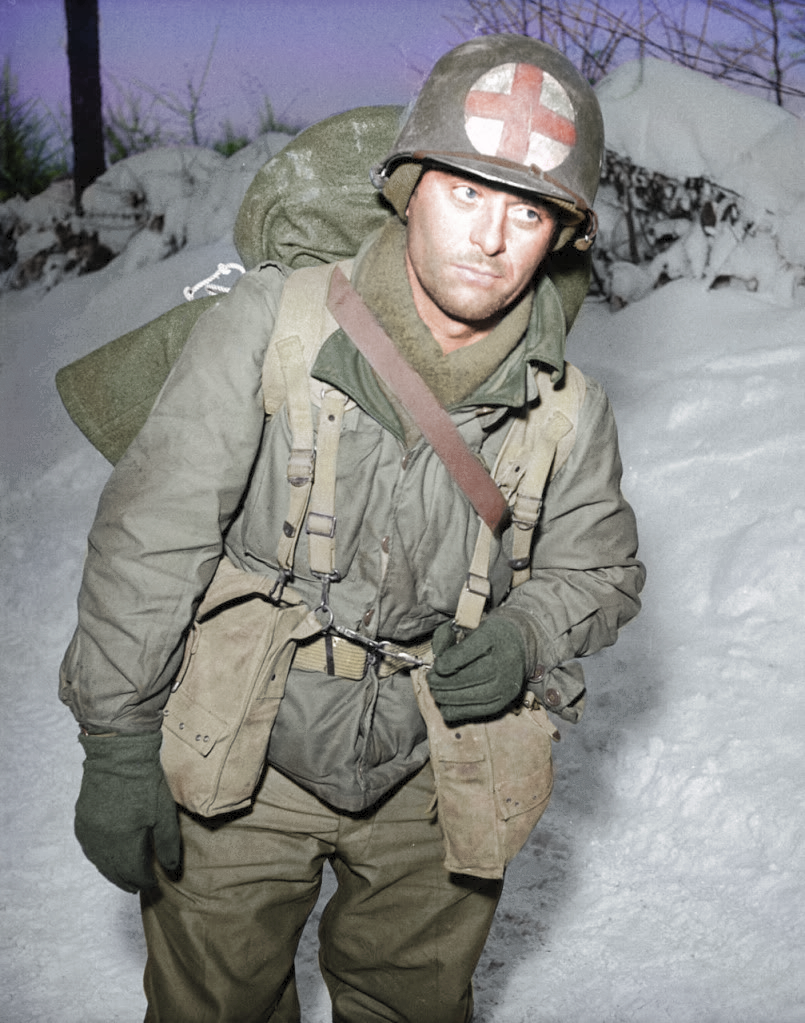
An exhausted American medic returning from the front during the Battle of the Bulge. Combat or field medics in World War II were military personnel prepared in a medical basic training, responsible for providing first aid and frontline trauma care on the battlefield. However, they could assist other units, even preparing patients for operations, making beds, or serving as cooks. Geneva Convention completely prohibits medics from using weapons. Medics could use a weapon to protect a casualty, but not themselves. Quoting Steven Ambrose, “It was the universal opinion of the front line infantry that the medics were the bravest of all.”
Photo source: Wikimedia Commons

In September 1944, Melvin deployed overseas as a member of the 394th Infantry Medical Detachment. By early November, he had reached France and soon after Belgium. His role placed him close to the front lines, where medics bore both responsibility and risk. Emergency treatment, casualty evacuation, establishing aid stations – these were the tasks he faced daily. Medics were often the difference between life and death, and they perform their duties under the most difficult conditions imaginable.

Service ran deep in the Schenck family. Three of his brothers also wore the uniform. Aaron served as a technician fifth class with the ski troops in Italy. Edgar became a captain with airborne forces in Holland and Germany. Donald, a yeoman first class with the Navy Seabees, served throughout the Pacific. Each son stepped into a different corner of the conflict, carrying the weight of duty in their own way.

Report By Major Stephen M. Gillespie

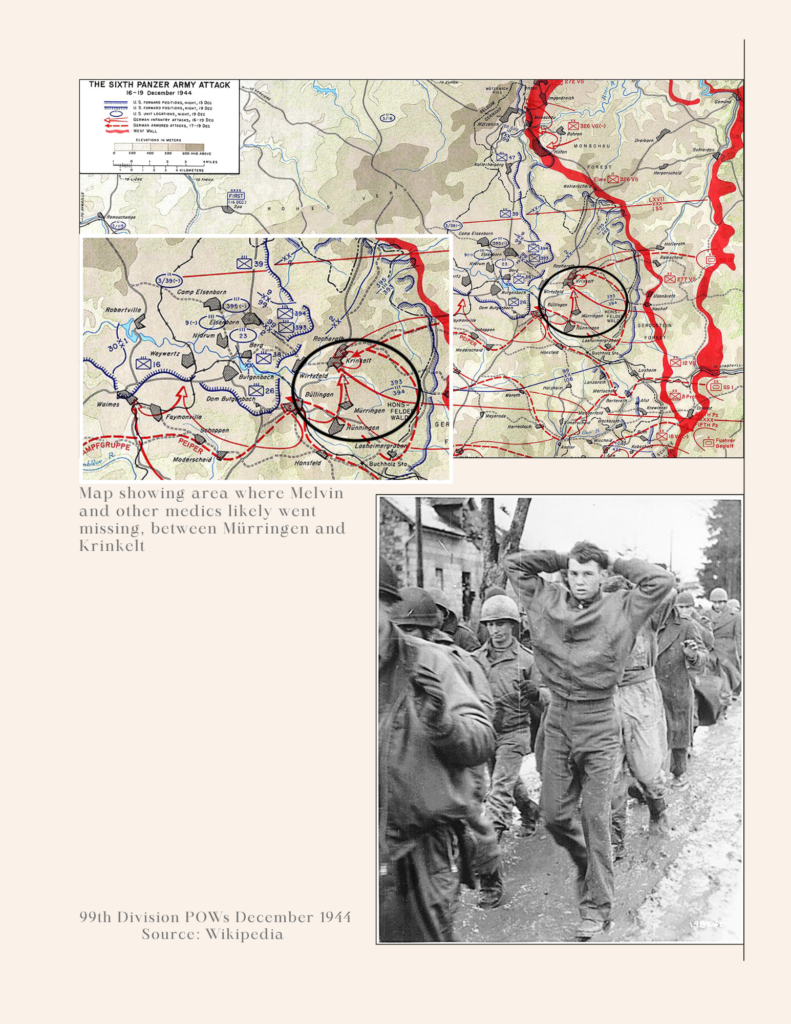
The final chapter of Melvin’s service unfolded during the battle of the bulge, when the German counteroffensive tore through the Ardennes in mid-December 1944. Major Steven M Gillespie’s report, a stark accounting of those days, describe the chaos that engulfed Melvin’s unit.

At 5:00 a.m. on December 16th, heavy artillery fire began pounding the village of Hunningen. The barrage continued relentlessly for two full days. On December 17th, at 2:00 p.m., the troops were ordered to withdraw to Murringen. The medical detachment moved with them, establishing aid stations in the basements of shell torn houses.

The shelling resumed that night, forcing personnel to shift patients into a cramped cellar. With no electricity, they relied on candles and flashlights to care for the wounded. For two nights they endured constant bombardment, sleeplessness, and a lack of food.

Shortly after 1:45 a.m. on December 18th, word arrived that the regiment must withdraw again, this time at 2:30 a.m. No ambulances were available. Medics unloaded a 2 1/2-ton truck of supplies so the wounded could be transported, while other personnel boarded a regimental CP truck. Officers traveled separately by jeep. Within moments, an order came to abandon all vehicles due to enemy action.

The troops continued on foot toward Krinkelt, with Camp Elsenborn as the ultimate destination. Once they reached Elsenborn, a devastating realization emerged: one-third of the detachment was missing. Melvin was among them. the regimental CP truck, carrying wounded soldiers and medical personnel, had not arrived.

Later reports revealed the truck had been ambushed outside Murringen. Five passengers were wounded. The remaining Battalion Aid stations and company aid men  moved out again that afternoon to return to the front. This sector – Elsenborn Ridge – would become the only part of the American line where German forces failed to advance. Medics like Melvin played a critical role in that desperate stand.

Two dead American soldiers at a road intersection. Photo probably taken at Murringen on December 17, 1944. Source: Wikimedia Commons
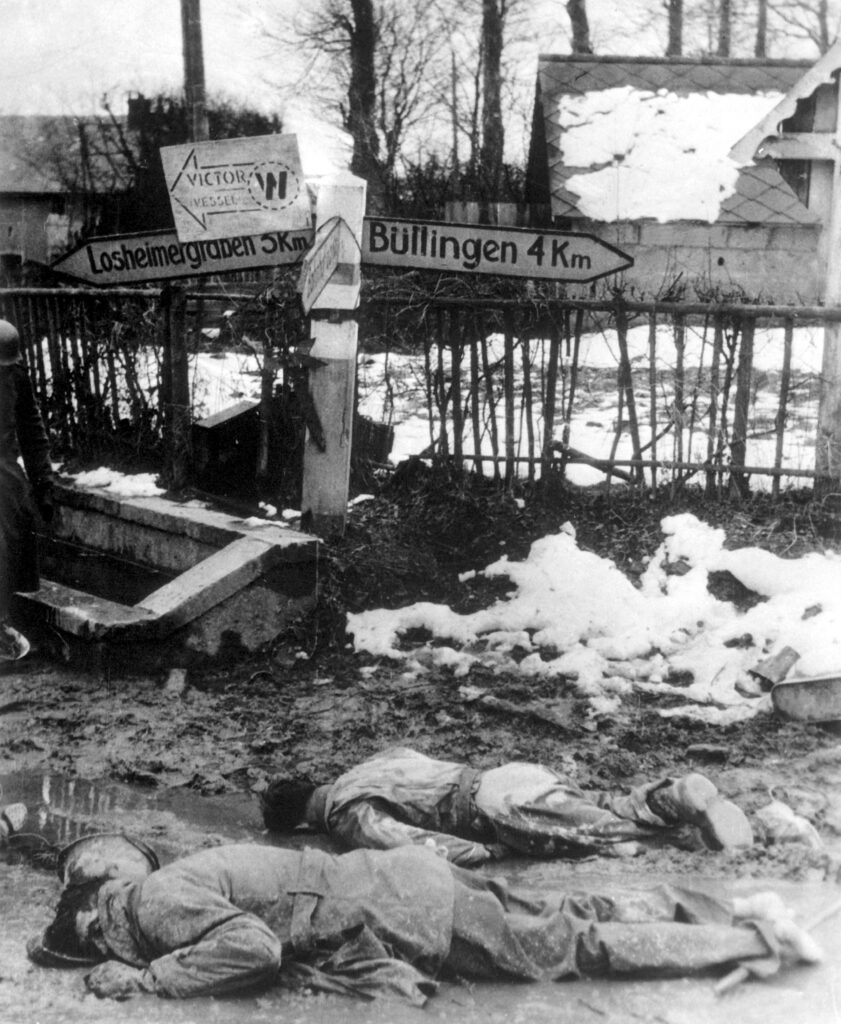
Two dead American soldiers at a road intersection. Photo probably taken at Murringen on December 17, 1914. Source: Wikimedia Commons

Later reports revealed the truck had been ambushed outside Murringen. Five passengers were wounded. The remaining Battalion Aid stations and company aid men  moved out again that afternoon to return to the front. This sector – Elsenborn Ridge – would become the only part of the American line where German forces failed to advance. Medics like Melvin played a critical role in that desperate stand. 
Newspaper Reports Back Home

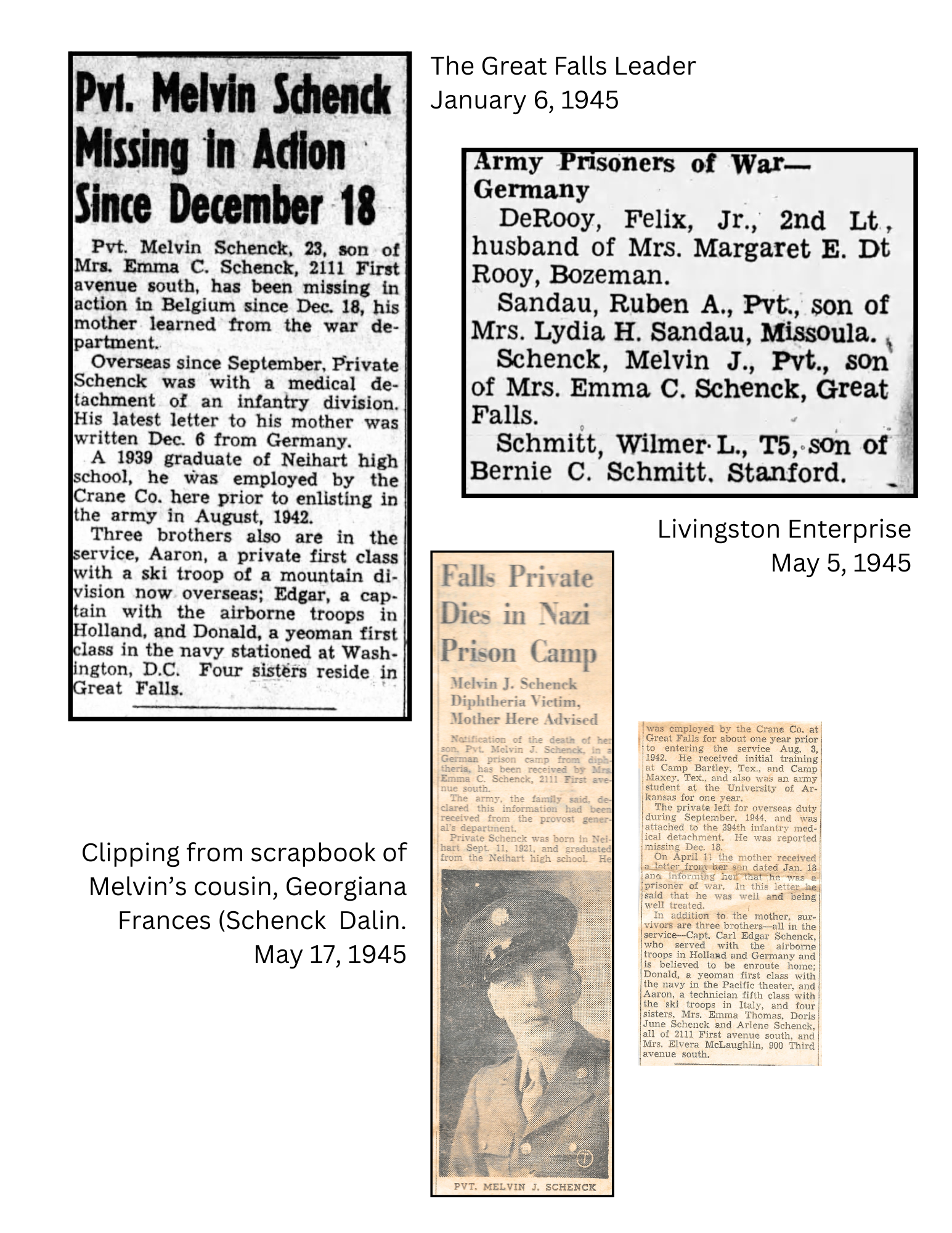
In Montana, the war reached Melvin’s family in fragments of newsprint. A Great Falls newspaper article dated January 6 reported him missing as of December 18, 1944. The announcement offered no details – only absence and uncertainty. His mother could do nothing but wait and pray.

For months she lived in that uncertainty, watching the war unfold in headlines while imagining her son somewhere in its vast machinery. On December 17, just one day before Melvin was reported missing, the Malmedy Massacre had taken place in Belgium – a brutal execution of 84 American prisoners of war. The event occurred near the area where Melvin had last been seen. For a mother already weighed down with fear, such news must have deepened her worry in ways words cannot fully express.
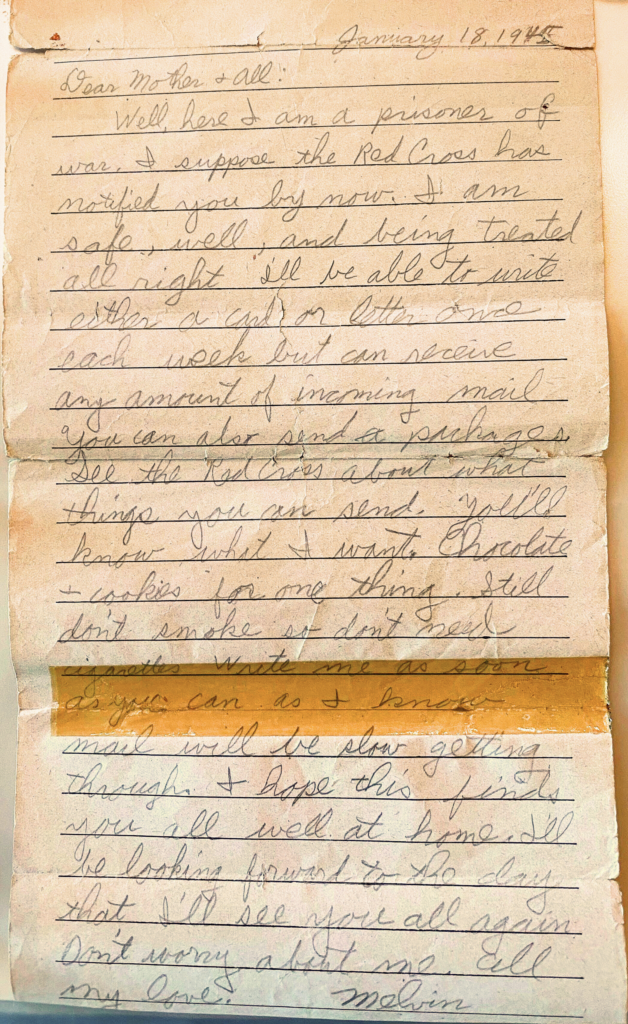
At last, on April 11, a letter arrived in her mailbox. It was from Melvin. He confirmed that he was a prisoner of war and wrote that he was “well and being well treated.” He asked if she might send chocolate and candy. But the letter was dated January 18. Nearly three months had passed between the moment he wrote those lines and the day she held them in her hands. Still, the message offered hope. He was alive.

Another month passed. The war was clearly nearing its end, and she must have prayed that liberation would come in time. When Germany unconditionally surrendered on May 7, she held on to hope for good news.

But on May 17, the Army notified her that her son had died of diphtheria on March 11, 1945, in a German prison camp. Only later did she realize that Melvin had already been gone for a month when she received his comforting letter in April.
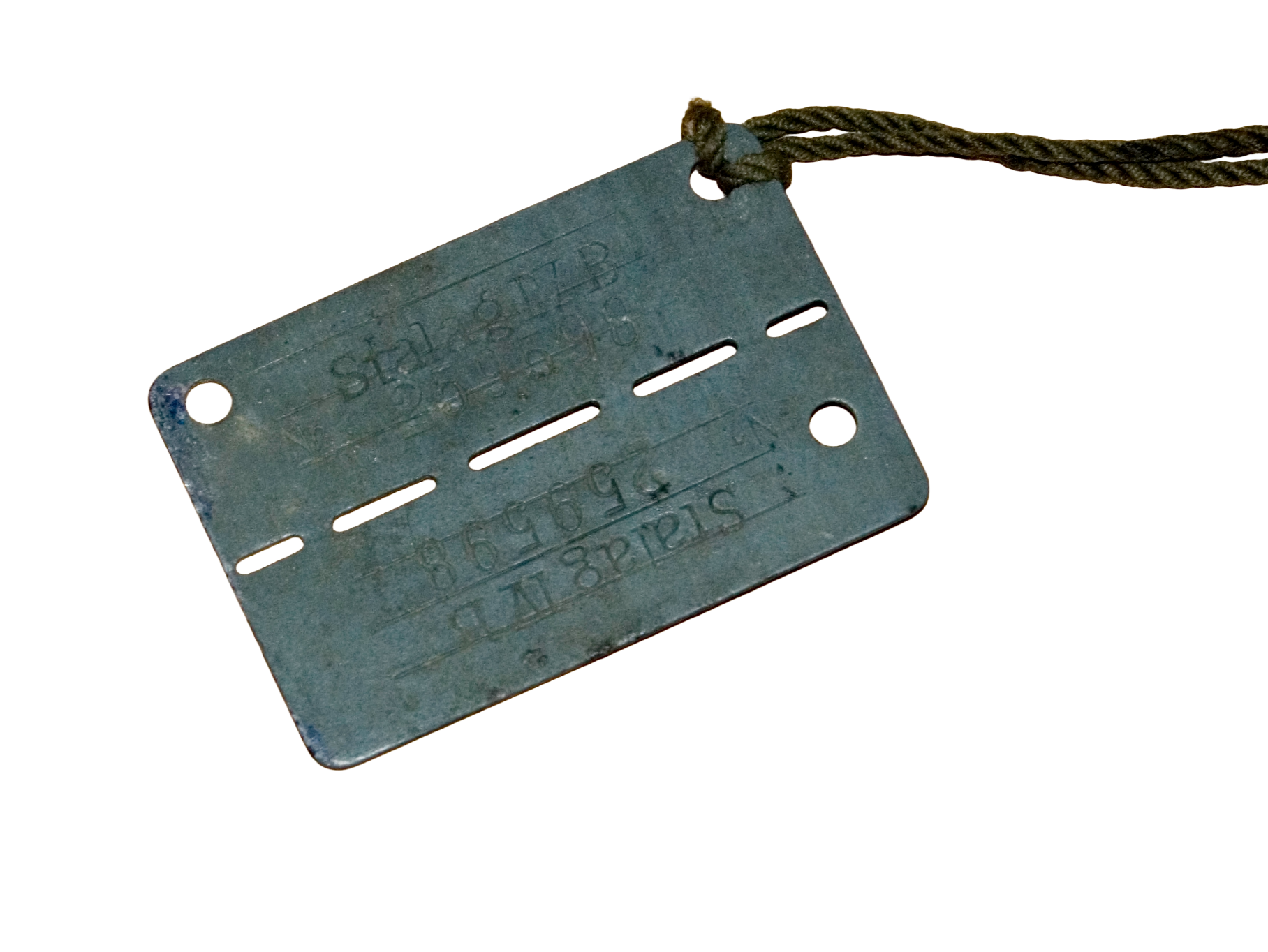
Stalag IV- Muhlberg

Melvin had been sent to Stalag IV-B Muhlberg, one of the largest prisoner-of-war camps in Germany. Designed to hold 15,000 men, it swelled to more than 30,000 during the final months of the war. After the Battle of the Bulge, 7,500 American soldiers were brought there, joining prisoners from thirty-three nations. Overcrowding led to shortages, disease, and harsh living conditions. Tuberculosis and typhus swept through the camp. By the time Soviet forces liberated it on April 23, 1945, approximately 3,000 soldiers had died within its barbed-wire boundaries.
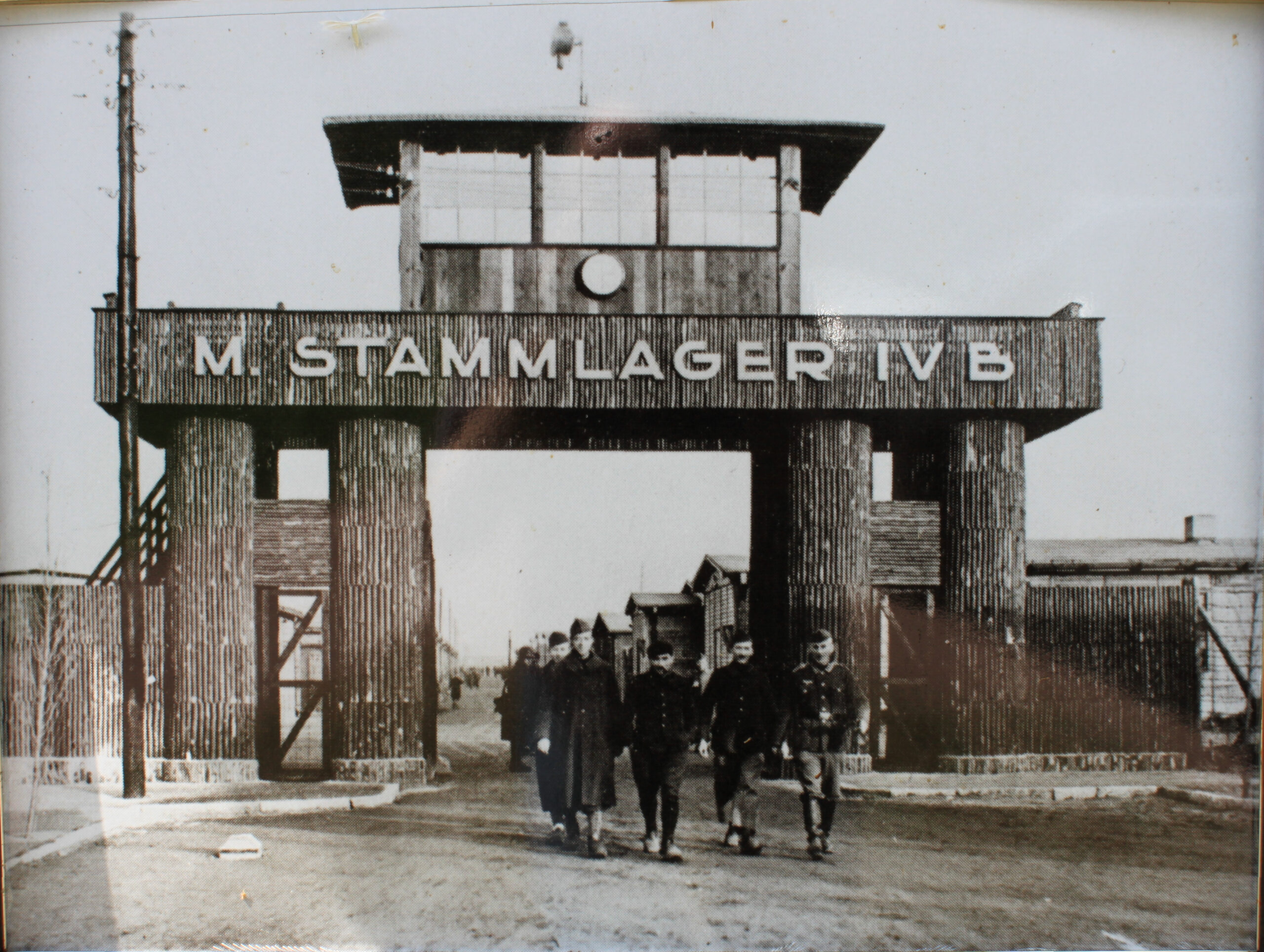
Melvin was one of them. A young man who once dreamed of becoming an engineer, who loved mathematics and Shakespeare, who had never traveled outside Montana until the Army sent him across an ocean – his life ended far from the snowy mountains of his childhood.

Yet his story remains. It is carried in family memory, in official records, in the courage displayed during his final days of service, and in the quiet resolve of a young medic who gave his strength to save others. His life, though cut short, is honored in the history he helped shape.

Epilogue

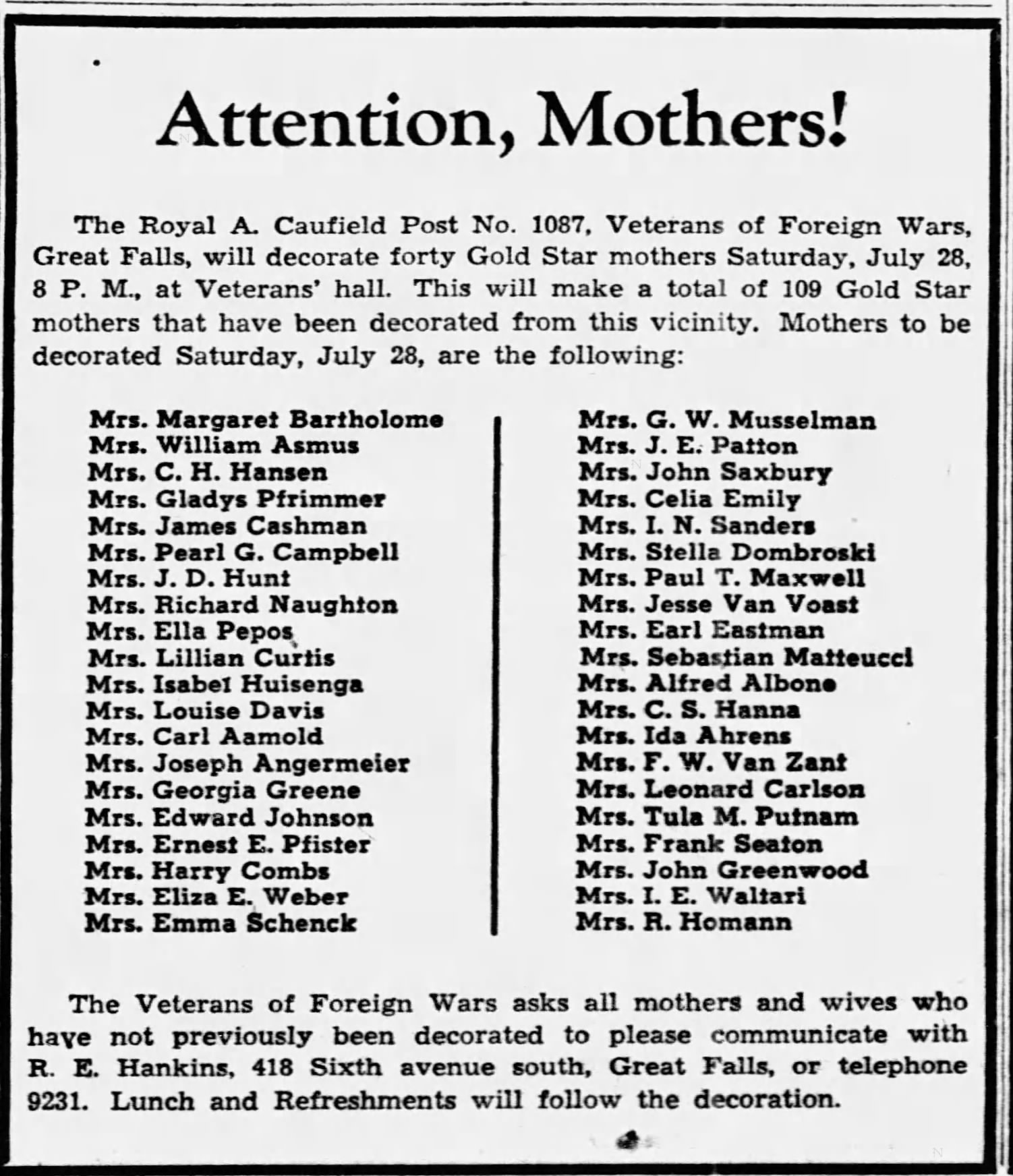
On Saturday, July 28, 1945, Melvin’s mother, Mrs. Emma Schenck, was decorated as a Gold Star mother at the Veteran’s hall in Great Falls. She was among forty women to have been decorated that day, making her one of 109 Gold Star mothers in that vicinity.
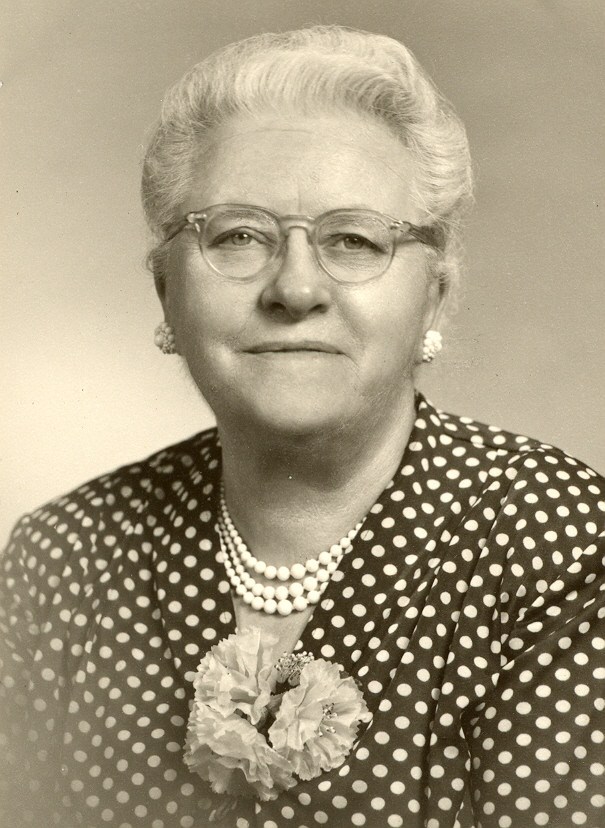
In 1949, she was seated as Sergeant at Arms for the same organization.
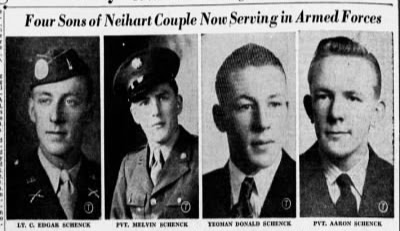
Left to right: Carl, Melvin, Donald and Aaron

Captain Carl Edgar Schenck served with the airborne troops in Holland and Germany. Donald, Yeoman first class, served with the Navy in the Pacific Theater. Aaron served with the ski troops in Italy as a Technician fifth class.

All three returned home safely.
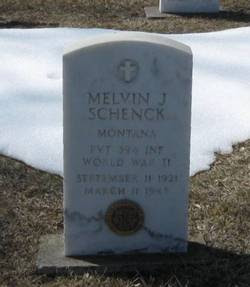
Melvin is buried in Highland Cemetery, Great Falls, Montana.


What This Story Means to Me

I did not grow up knowing the name Melvin J. Schenck. His story was not told at family gatherings, nor did I ever hear my father-who was Melvin’s cousin-speak his name. For many years, Melvin existed only as an absence, a branch on the family tree left unexplored.

I first discovered him by accident. While researching my paternal grandmother’s surname, SCHENCK, I stumbled across a military document listing missing personnel from World War II. There, among dozens of names, was a young man from Montana whose details felt uncannily familiar. At first I wasn’t sure if we were related, or whether he belonged to another Schenck line entirely. But the curiosity stayed with me.

Some time later, while looking through my grandmother’s scrapbook, I found a small newspaper clipping tucked between other family mementos. It reported a local soldier missing in action: Melvin J. Schenck. That fragile scrap of newsprint confirmed what I had begun to suspect. He was a member of our family.

The more I learned, the more I felt compelled to understand who he had been.

Several years ago, I met Melvin’s nephew Clayton and his wife Kathy, an experienced genealogist, who generously shared treasures that brought Melvin’s voice back across the decades: a copy of the letter he wrote to his mother from a prisoner-of-war camp, and an autobiography he penned as a high school senior. In those pages, I met a young man who loved mathematics, read Shakespeare for pleasure, and dreamed of becoming an engineer. His humanity-his personality-emerged with a clarity that both delighted and humbled me.

Writing this biography is my way of gathering the pieces of Melvin’s short life and placing them where they can be seen. His story is not only one of wartime sacrifice; it is the story of a boy from the Montana mountains, a son and brother, a medic who served with quiet courage, and a young man whose dreams stretched far beyond the world he knew.

By preserving his story, I hope to restore him to our family’s memory-and to ensure that future generations will know not just that he lived, but who he was.

It is an honor to tell his story.


Author Note #1: Much of the information in The Early Years chapter came from a three-page autobiography Melvin wrote during his senior year in high school. Much thanks goes to my cousins Clayton and Kathy for their friendship and for sharing the autobiography.

Author Note #2: Source for Major Gillespie’s report: National Archives and Records Administration, Record Group 407, Records of The Adjutant General’s Office, U.S. Army, World War II Unit Records, Records of the 99th Invantry Division, 394th Infantry Regiment, 14 Nov 44 – 25 Aug 44, Box 1419.

Author Note #3: Future generations should know that this piece was created during a time of technological transition. Artificial Intelligence was in the infant stages. AI assisted in editing of this story. Research, interpretation and storytelling reflect the author’s work, curiosity and dedication to preserving this story.
A Merrily Burning Fire on Rodney Street

This blog post is written in response to Amy Johnson Crow’s invitation to participate in the 2026 52 Ancestors in 52 Weeks Challenge. Prompt for Week 2: A Record That Adds Color


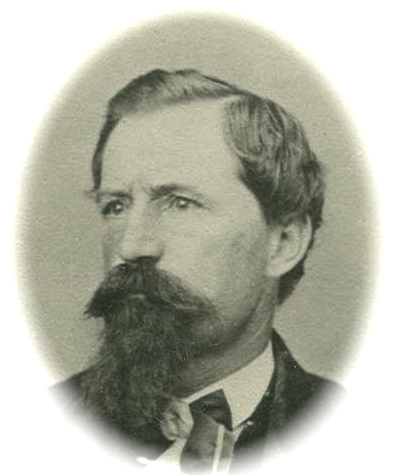
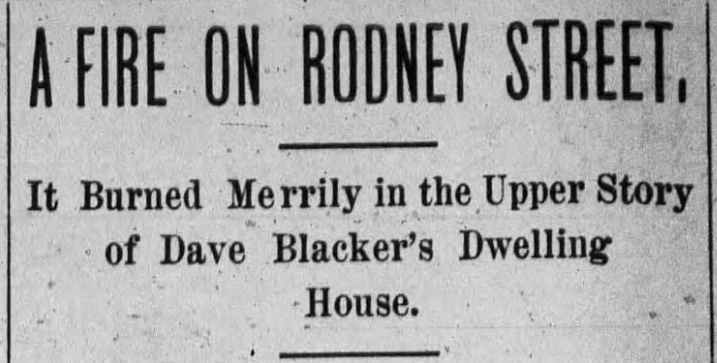
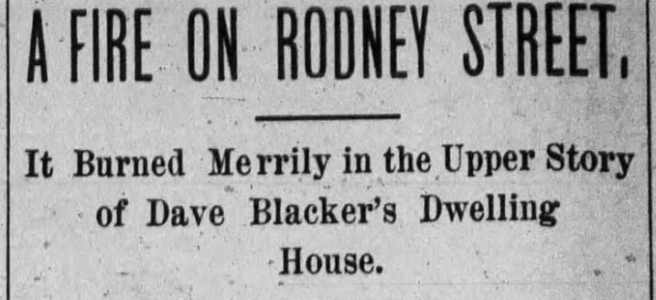
A few weeks ago, while plunging into the ancestral rabbit hole of my mom’s paternal line—her grandparents Ada and David  Blacker—I unearthed a rather colorful article on page eight of the Helena Evening Herald, dated July 23, 1892. The main title, “A Fire on Rodney Street,” was certainly alarming. But the subtitle, ever the mood-setter, playfully undercut the drama: “It Burned Merrily in the Upper Story of Dave Blacker’s Dwelling House.”

The opening line, which breathlessly declared, “A fire this morning in the residence of Dav. Blacker, 335 North Rodney street, came near proving most disastrous,” immediately grabbed my attention.

Then came the culprit. “A little child of Mr. Blacker, going on three years of age, was alone in an upper room, and by some means, it is supposed, secured possession of a match . . . [which] was ignited and fire set to the inflammable window curtains.” My immediate, slightly baffled, thought was: How did my mother, who shared every family story under the sun, never mention the time her own father nearly barbecued the family home? Perhaps it was one of those stories that got left off the syllabus.

The article goes on to explain that the parents, downstairs at the time, “heard the child scream.” They flew up the stairs to find the center bedroom enthusiastically engulfed in flames.

The newspaper’s description of the small arsonist is pure gold: “The child had evidently watched the conflagration with much wonder and interest until it severely felt the heat, then warning was given by a scream.” A budding pyrotechnician, that one!

Fast-forwarding to the rescue: the mother sprinted to the back stairway “just in time to catch the little one, which was on the point of falling down stairs.” Meanwhile, the father heroically “dashed water on the flames and soon had them subdued.”

Reading this article was an absolute roller coaster. The good news, of course, is that my grandfather was apparently uninjured—a survivor of his own childhood curiosity.

The family’s possessions were not so lucky. The fire claimed the window curtains and oil paintings, while “the carpets and other material [were also] damaged. All glass in the windows was broken by the heat, as well as a looking glass.”

In a moment of classic small-town drama, someone tried to call the fire department, but “it was found that none of the four keys in the neighborhood would fit the alarm box, strange as it may appear.” Fortunately, the department’s services were not needed that day, though the article dryly concluded that “this may not be the case in every instance, and the department should see that proper keys are furnished.” Sound advice for a 19th-century fire marshal.

A few notes on the Blacker residence itself:

  • 1882: Ten years before the little firebug incident, the Montana Record Herald announced the completion of the house on Rodney Street, reporting “it will be, when completed, one of the handsomest private residences in the city.”
  • 1887: The couple’s daughter Helen was born there.
  • 1889: Jack “the fire-starter” was born in the Rodney Street house.
  • 1898-1911: Numerous social events were held in the Blacker residence, including church sales, afternoon teas, informal “fancy work” affairs, and several weddings, including the wedding of their daughter Helen. My favorite event is the hammock party hosted by 15-year-old Helen in 1902. The Montana  Record-Herald reported that “The hammocks [occupied by the girls] were strung under the trees in various parts of the yard” and “the boys went from one to another and told their story to the occupant of each. Later in the evening the girls compared notes and decided which of the boys had told the best story. Refreshments were served and  music ended the pleasant evening.”
  • January 1911: The house made its first of many appearances on the “Delinquent Tax List” in The Independent-Record. It is suspected, but not confirmed, that Mr. Blacker took a serious financial hit during the Panic of 1893, which may account for this turn of events.
  • April 1911: David Blacker died in the house a few months after it was listed for delinquent taxes.
  • March 1912: David and Ada’s daughter Helen was married in the family home.
  • 1914: A tax deed was issued to Lewis & Clark County, though Ada and her daughters continued to reside on the premises.
  • April 1923: The funeral of Ada’s mother, Catherine, was held in the residence.
  • April 1929: The property was finally sold, and Ada and her daughters relocated to a smaller home just around the corner on 7th Avenue.

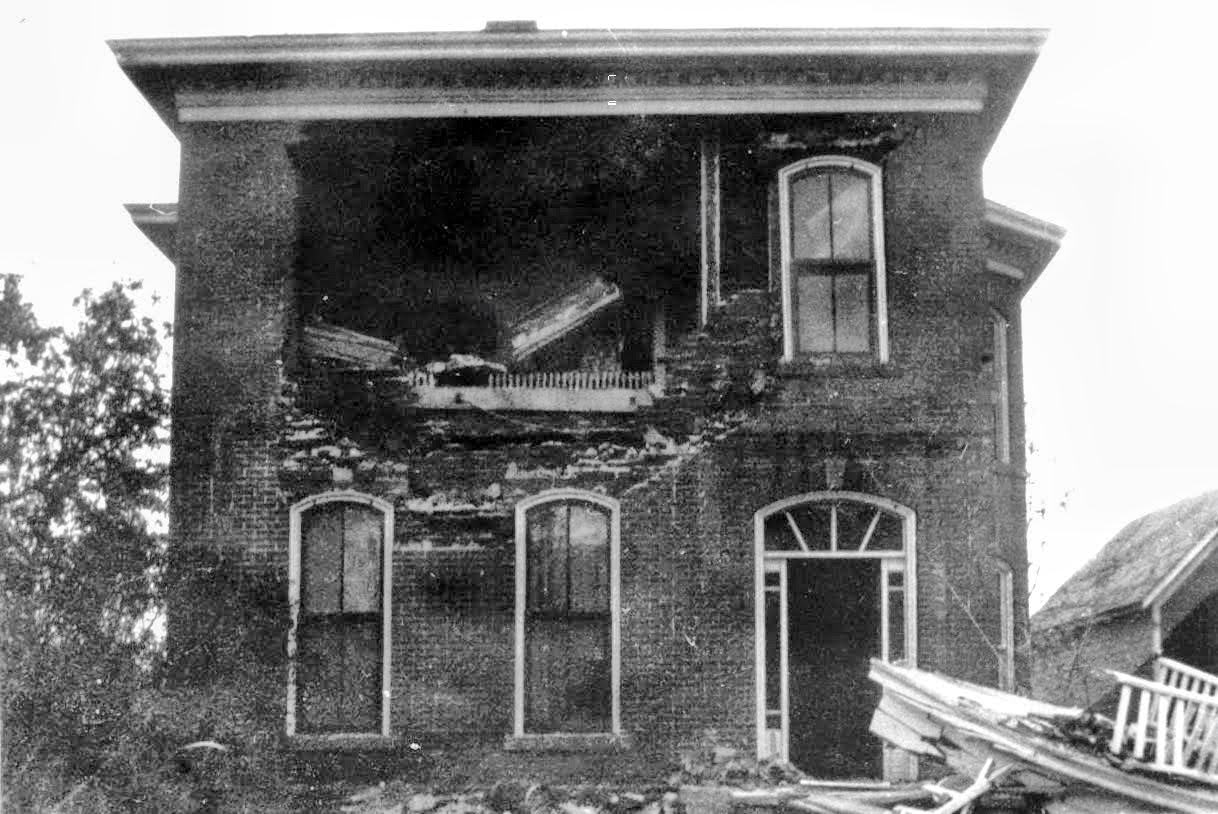
1935: On October 18th, the house sustained serious damage from a 6.2 earthquake that famously destroyed the new Helena High School and leveled the Lewis and Clark County Hospital. High schoolers had to finish the year attending classes in railroad coaches.

The house on Rodney Street, located in the original Helena Town Plat, was restored following the earthquake and happily stands to this day.


Sources for this story include:

  • Newspapers.com – Helena Evening Herald – Helena, Montana – 23 Jul 1892 – “The Fire on Rodney Street” – Page 8
  • Newspapers.com – The Montana Record Herald – Helena, Montana – 15 Aug 1882 – “On Dit” – Page 3
  • Ancestry.com – 1900 United States Federal Census – birth month and year of Helen A. Blacker
  • Ancestry.com – Montana, U.S., Birth Records, 1897-1988 – birth record of John David Blacker
  • Newspapers.com – The Montana  Record-Herald – Helena, Montana – 15 Jun 1902 – “Hammock Party” – Page 9
  • Newspapers.com – The Independent-Record – Helena, Montana – 1911 Jan 30 – “Delinquent Tax List” – Page 7
  • Newspapers.com – The Independent-Record – Helena, Montana – 31 Mar 1912 – “Swezey-Blacker” – Page 10
  • Newspapers.com – The Independent-Record – Helena, Montana – 4 Aug 1929 – “County Given Tax Deed in 1914; Are Unpaid City Taxes Lien, Courts Asked” – Page 1
  • Newspapers.com – The Montana  Record-Herald – Helena, Montana – 23 Apr 1923 – “Burial Rites Held for Mrs. Buchenau”
  • 1935 image of earthquake damage to house on Rodney – “Earthquake Gallery” – courtesy of “Helena As She Was” website at http://helenahistory.org/
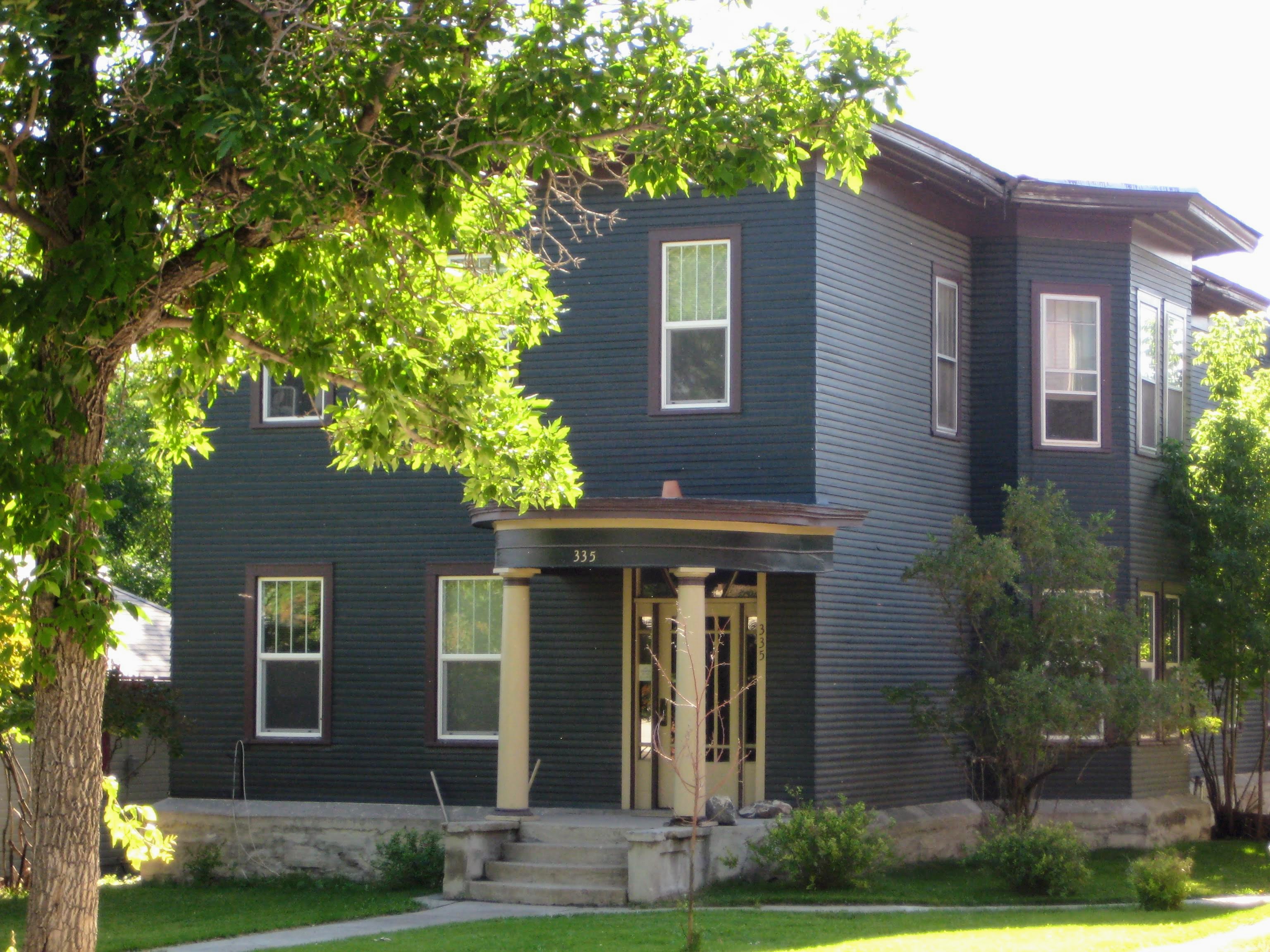
  • Recent photo of house on Rodney taken by author – 15 Aug 2008

Author note: Future generations should know that this piece was created during a time of technological transition. Artificial Intelligence was in the infant stages. AI assisted in editing of this story. Research, interpretation and storytelling reflect the author’s work, curiosity and dedication to preserving the Blacker/Buchenau Family Legacy.

I hope you enjoyed it!

~ Lark

“A Little Room for Doubt” – The Suicide of Mary Knaff

This is a true story about an event in the life of my great grandfather Joseph Kieran in 1902, offered here in the writing style known as “creative nonfiction”.

————

“Come quick!”, the young boy said. Your cousin . . . your cousin Mary! She’s dying!!

As he hurried out the door, following the messenger headed down the hill on North Wyoming street, Joseph was perhaps only a little surprised to hear the disturbing news. Mary had paid him a visit just a few weeks prior to talk about how despondent she’d been feeling. He was very concerned for her even then but knew there was very little he could do to help.

Feeling a keen sense of urgency, he began to pick up his pace for the often-travelled 15-minute walk to his cousin’s house.

When he finally arrived late that Sunday afternoon, there were several people at the house. Mary’s husband John, Dr. Sullivan, Lilly Finley (a former boarder that Joseph knew), and a few other women he didn’t recognize. And Mary, of course, who was lying on the sofa in a terrible state . . . just barely alive.

Dr. Sullivan explained that he was summoned earlier by Father Calahan to Mary’s home where he learned that Mary had ingested carbolic acid at around 3 o’clock that afternoon. Dr. Sullivan immediately made his way to her house, stopping at a drugstore to pick up some antidotes. But there was not much he could do by the time he arrived that would afford any hope. 

The mood in the room was somber. 

Overcome by his emotions, Joseph immediately confronted Mary’s husband John, crying out, “Well, you are satisfied now, are you? “You have driven her to kill herself!”

Another doctor arrived about an hour later and, after consulting with Dr. Sullivan, agreed there wasn’t much that could be done.

Joseph slowly dropped into a chair near his cousin, and began to recall the details from their last visit together.

He knew Mary had been forced to take in boarders in order to support herself and her husband. He also recalled Mary telling him that John had only worked about three weeks since the prior December; and that he was recently coming home late at night, eventually arriving drunk; and sometimes would even be gone for several days at a time. 

And then there was the story about a man who showed up at their home and threatened to shoot John if he didn’t stop seeing his wife.

Mary also told Joseph that she often wished she was dead because her life had become so miserable.

Joseph suggested that she bring her things and come and stay at his house. He and his wife Kate operated a boarding house and they could surely make room for her. But after much discussion and urging on his part, Mary reluctantly declined his kind offer, saying she didn’t want to break up her marriage.

As Joseph realized that his cousin’s marital problems were even more serious than he had realized, his thoughts of that last visit were bluntly interrupted when he heard John emotionally beg for a revolver so that he could shoot himself. One of the women in the house offered to get him one. Joseph didn’t think he had any intention of using it. He thought John was “running a bluff”.

Mary died that evening. Sunday, April 28, 1902 at 7 pm. 

An inquest was held the next day at the undertaking rooms of the Montana Undertaking Company in Butte, Montana.

John Boyle, a friend of the couple who was present in the house about an hour before Mary drank the carbolic acid, testified that he’d known the couple for five years. He was only at the house for about 15 minutes and didn’t hear or see anything unusual.

Mrs. James Flynn, a former neighbor, testified that Mary told her about the woman whose husband had threatened John. She also testified that Mary often shared with her that she was displeased and at times and wished she was dead because she had a miserable life.

Miss Lilly Finley testified that she was at the house with Mary in the morning, and until John came home at about 2 o’clock that day. John left the house at about 8 o’clock a.m., before she arrived.

Miss Finley also described an incident that occurred early in the afternoon where John was hiding two dollars from Mary. She wanted one dollar and he wouldn’t give it to her. Sometime afterwards Mary went into the front room, came back out and told John and Lilly to “go for a doctor” and her cousin because she was dying. 

Lilly went next door to tell Mrs. Irvine, the neighbor. Mrs. Irvine went for Father Calahan and her husband went for the doctor. Lilly also testified that she found a “regular beer glass” that seemed to have been about two-thirds full of carbolic acid, with only a sign of it left.

Several of the witnesses, including Lilly Finley and Mrs. James Flynn, agreed that Mary Knaff committed suicide due to her despondency over the situation with her husband. They all reported that she had been “wasting away” over the last few months.

Dr. Sullivan testified that Mary had burns on her face when he arrived, as well as the odor of carbolic acid on her breath. Her pupils were characteristic of carbolic acid poison, which “is about the same as opium poison . . . but she had gone beyond that, she was about dying.” Dr. Sullivan tried to administer some whiskey, which he stated was the best antidote but her throat was paralyzed. He also gave her a hyperdermic injection of strychnine to “keep the heart up”, but it was too late to save her.

Mary’s husband John testified that the couple “never had any trouble whatsoever”. As to the two dollars, he stated he was going to give her that money but he couldn’t remember where he put it. Later, he stated he was just teasing her. 

Oddly, he did not remember seeing Lilly Finley at the house until after his wife announced she was going to die. 

Early in his testimony, John Knaff testified that he and Mary had five children, but all were dead. There were no follow-up questions by the coroner or any of the jurors on that point.

Joseph Kieran had a slightly different take on the situation.

When asked by the coroner, “Is it your opinion, Mr Kieron, that the ill treatment of Mrs Knaff had anything to do with hastening her death?” He replied, “Yes sir, it had everything to do with it . . . sometimes she would say that she would break up housekeeping and other times she would tell me she didn’t want to, it was pretty hard.”

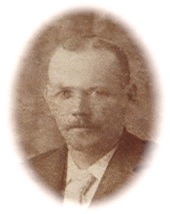
Joseph Kieran

Pushing for clarification, the coroner asked, “It is your opinion, between his dissipation and staying out nights and drinking and his attention towards some other woman was bearing on her mind to that extent, that she took her own life as a relief?”

Joseph answered, “Yes, I believe it was all the cause of it, although I don’t know that she took her own life. I would not say she did. It looks to me a kind of a mystery . . . “

Question by the coroner: “ . . . have you any idea that there is any foul play connected with her death?”

Answer:  “ . . . according to the testimony I have listened to here now, it looks to me more than ever. Mr. Knaff claims this lady [Miss Finley] was not there . . . and I think it looks kind of suspicious to me to hear that evidence. It seems to me there is a little room for doubt about it.”

Six jurors arrived at the final verdict as follows:

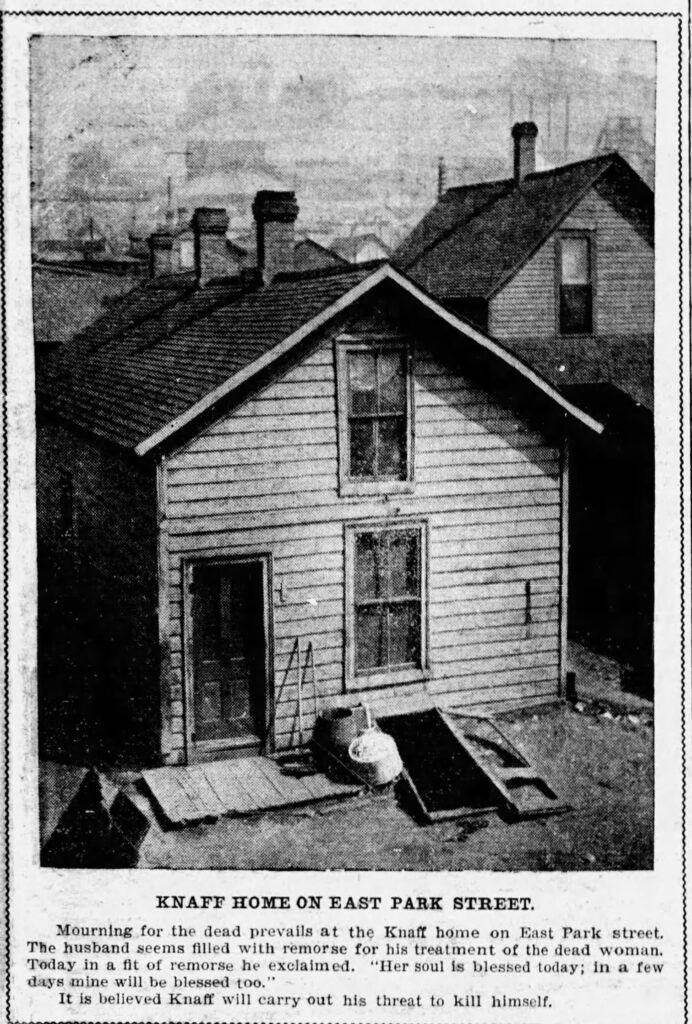
That the said Mrs Mary Knaff came to her death about 7:00 on Sunday evening April 27th 1902 at her home number 362 East Park Street alley in the city of Butte Silver Bow County state of Montana as the result of a dose of carbolic acid solution self-administered and we believe from the evidence that the said suicidal death was the direct cause of worry on the part of the said Mrs Mary Knaff due to ill treatment and abuse inflicted by her husband John T Knaff. The jury recommends that it is a lamentable fact that there is no law through which the said John T. Knaff can be punished for his gross neglect, infidelity and abuse of his wife, which prompted her to destroy herself.


Sources for this story include the following:

  • Newspapers.com – The Butte Daily Post – 28 Apr 1902 – Page 1
  • Newspapers.com – The Butte Miner – 29 Apr 1902 – Page 8
  • Inquest on the Body of Mrs. John T. Knaff dated 28 April 1902, obtained by author at the Butte Archives located in Butte, Silver Bow County, Montana

A few women named Nora

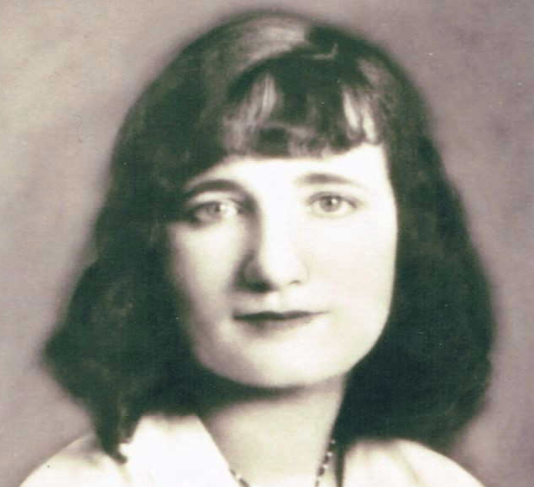
Nora Marie (Kieron) Blacker circa 1922

This is my maternal grandmother, Nora Marie (Kieron) Blacker. She was born 7 September 1900 in Butte, Montana. First generation Irish, her parents, Joseph Kieron and Kate Myers, both having been born in Ireland.

The first two namesakes

Two of her granddaughters were named after her. One carries her first and middle name, and I am honored to carry her middle name.

A little about my grandmother Nora

In August of 1970, on one of our many summer visits to my Mom’s home town of Helena, Montana, we made a trip over to Butte one afternoon. I remember driving around while Mom tried to remember where her Irish grandparents lived. Not an easy thing to do because her mother died when she was only 8 years old, and they didn’t visit Butte very often after that.

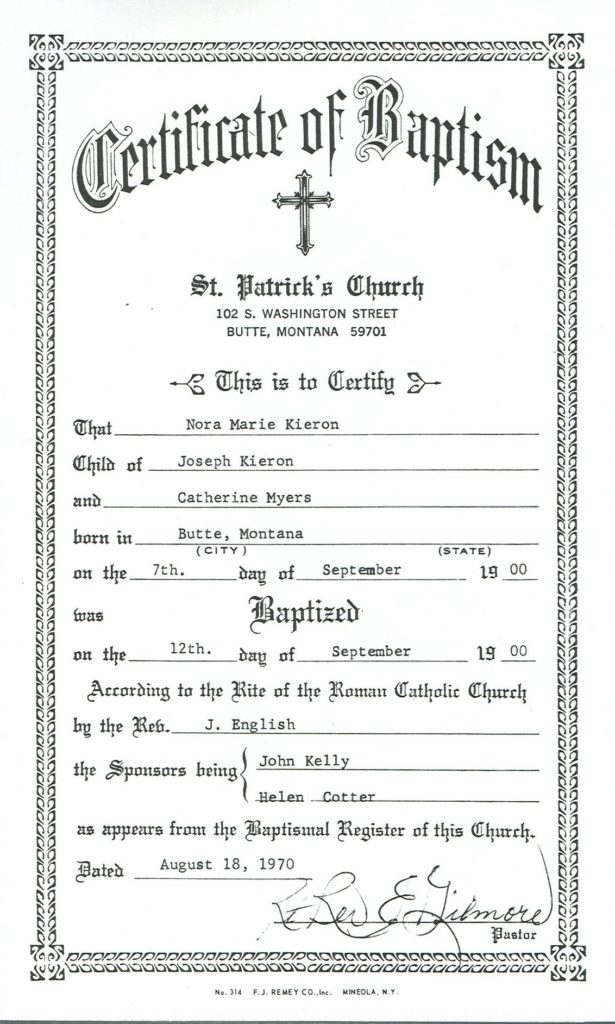
Nora’s Certificate of Baptism

One stop we made that day was St. Patrick’s Church on Washington Street. Mom wanted to see if we could get a copy of her mother’s baptismal certificate.

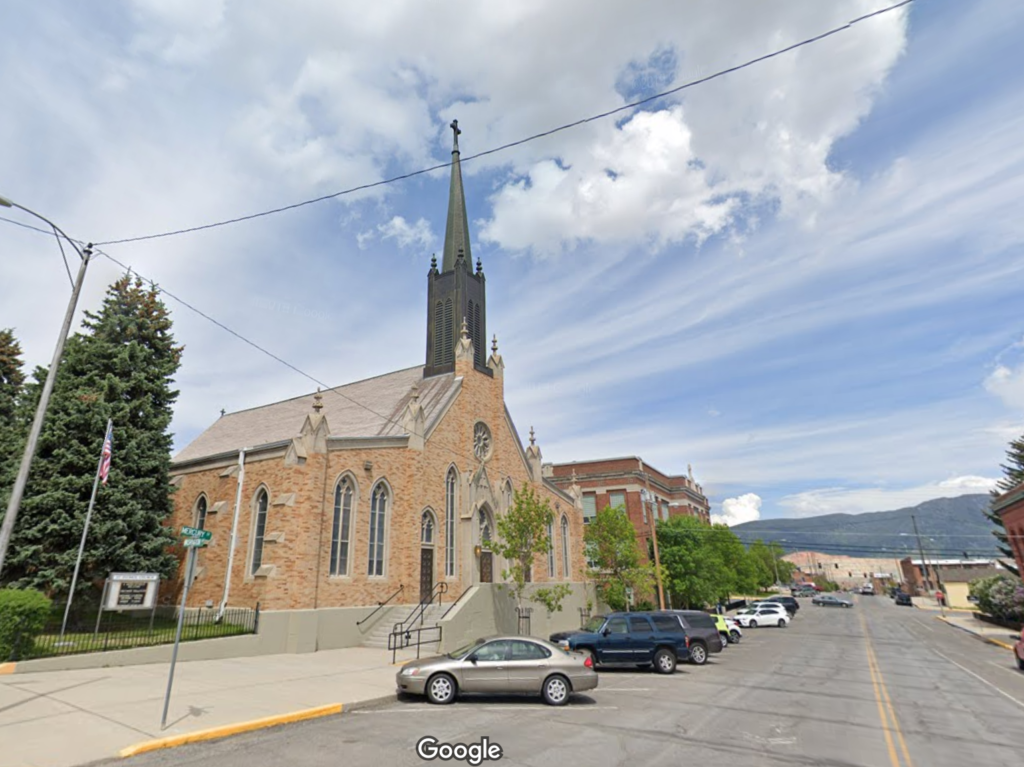
Google street view of St. Patrick’s Church in Butte.

The Certificate of Baptism we obtained that day turned out to be one of the first records we obtained after we began actively researching our family, way back in 1970.

Certificate of Baptism for Nora Marie Kieron, obtained from St. Patrick’s Church in Butte

At the time, the only new piece of information we gained from this record was the birth year of 1900. We had always believed Nora was born in 1902.

But as I reviewed this record again while preparing this post, I noticed two more bits of information that we didn’t pay much attention to in 1970.

Who is Helen Cotter?

First, one of the sponsors, Helen Cotter, seemed a very familiar name to me. It took me a few minutes to realize I had seen the Cotter surname before . . . maybe Nora’s parent’s wedding certificate?

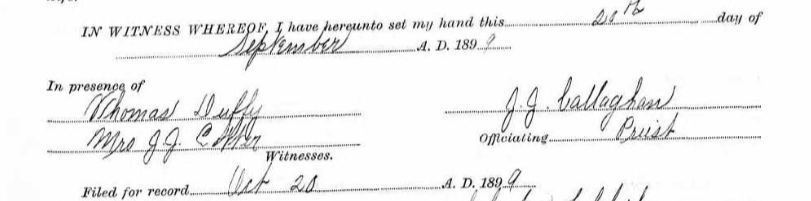
Sure enough. There she was . . . “Mrs. J. J. Cotter” listed as a witness. The woman who was a witness to their marriage was also listed as a sponsor for their daughter. Interesting. So, of course, I spent a good deal of yesterday researching her.

I was hoping to learn that Mrs. Cotter was perhaps a cousin to either Joseph or Kate. And while it appears that she is of Irish descent, she was born in New York and at this time I don’t think their paths crossed until they all ended up in Butte.

But I did learn one interesting thing about her.

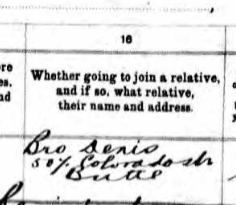
In 1900, Mrs. Cotter lived with her husband at 507 Colorado in Butte. Again, I recognized that address. After a little poking around, I located the May 1900 ship record of Kate’s brother Thomas, as well as the May 1901 ship record of her brothers Michael and Patrick. And the 507 Colorado address is referenced in all three ship records.

Ship record of Kate’s brother Thomas, showing the address of his brother Denis in Butte

And I noticed another bit of information on the baptism certificate. Nora was baptized five days after she was born, which is a bit unusual because most Catholic babies are baptized several weeks after they are born.

We knew Nora was born a twin. And we knew her brother Peter died several days after they were born.

Nora’s Church record

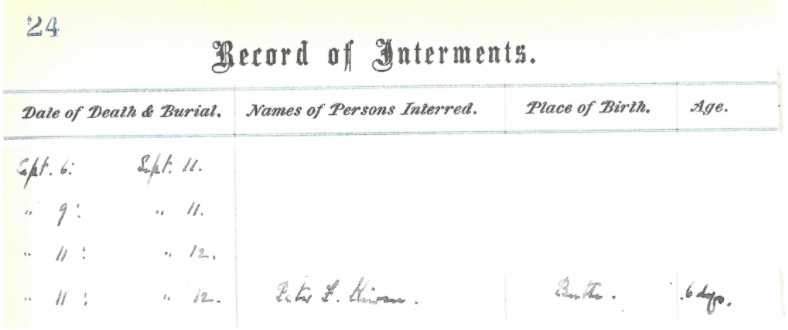
Many years later, we obtained a copy of the actual Church record, which states Peter died on September 11th, four days after the twins were born.

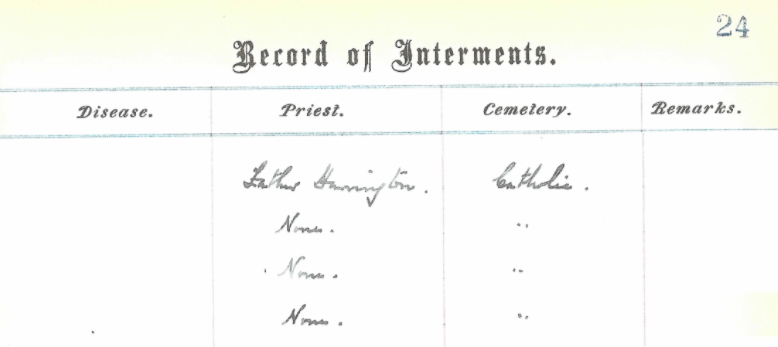
Per the last line of this record, Peter died on September 11th and was buried on September 12th. NOTE: The three lines above reference other individuals and their identity was redacted by the Church.
In this continuation of the Church record, we were told that “None” in the last line (Peter’s record) meant the child died before Father Harrington was able to administer Last Rites.

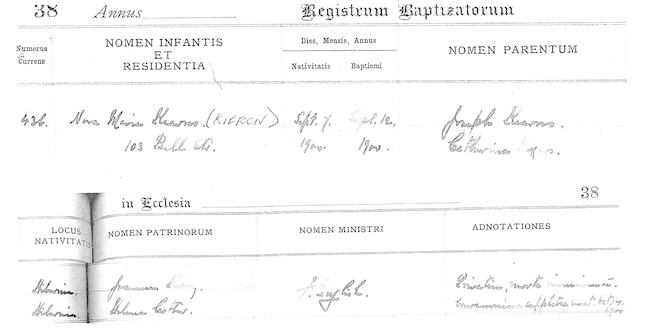
The record below is the entry for my grandmother Nora. The record, written in latin, indicates Nora was also very ill. She received an emergency baptism on September 12th, one day after Peter died and the same day he was buried. Also, note Helen Cotter named as the godmother in the bottom left-hand corner.

Another namesake?

According to Irish naming tradition, Joseph’s first born son was named after his own father Peter.

That story will have to wait for another day.

The record that knocked a hole in our Irish brick wall

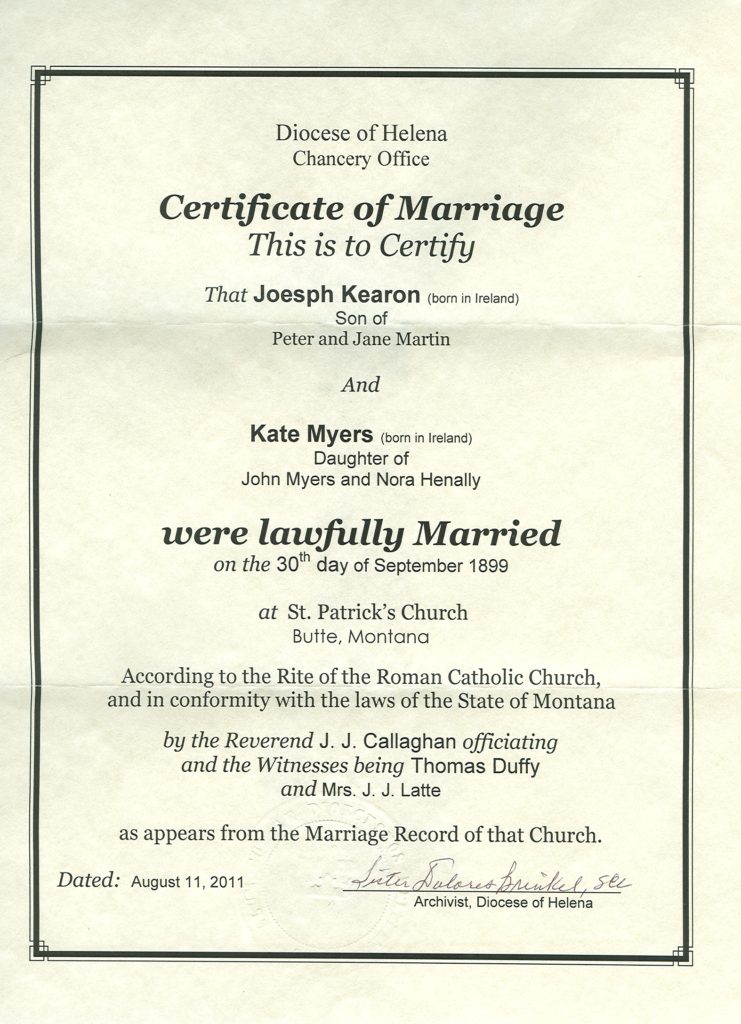
In the summer of 2011, my Mom decided we should pay a visit to the diocese office in Helena to see if there might be a record of the marriage of Nora’s parents, Joseph Kieron and Catherine Myers.

Certificate of Marriage for Joseph Kearon [sic] and Kate Myers

This record turned out to be the one that knocked a hole in our very large Irish brick wall. And that’s because it gave us the names of Kate’s parents, John Myers and Nora Henally [sic]. That was a bit of information we’d never had before. In addition, it also confirmed the names of Joseph’s parents, Peter Kearon [sic] and Jane Martin.

Subsequent civil documents revealed that Joseph was born in Drumgoosatt Townland, County Monaghan, Ireland, and Kate was born in Ower Townland, County Galway, Ireland.

Armed with the names and specific locations of our Irish ancestors, that Irish brick wall finally came tumbling down.

A little about Nora Hennelly

If you have an Irish line in your family, you know how difficult Irish research can be. But I’ve learned a little about her.

She was born in about 1833, either in County Galway or County Mayo. She married John Myers of Ower Townland, County Galway, in about 1858 or 1859. The couple had nine children between about 1860 and 1879.

Nora’s oldest daughter Julia stayed in Ireland, as did her oldest son John who inherited the family’s small farm. The remaining seven children, two daughters and five sons, all were forced to leave in order to have some chance for a better life elsewhere.

Both daughters ended up in America. My great grandmother Kate in Butte, Montana, and her sister Delia in Helena.

One of the five sons ended up in England and the other four joined their sisters in Montana.

A big family mystery

What happened to four of Nora’s sons?

Possibly the biggest mystery in our family involves Nora’s sons, Denis, Thomas, Michael and Patrick.

As stated above, all four immigrated to America in 1900 and 1901, and immediately made their way to Butte, Montana where they found work in the copper mines.

Shortly after the deaths of their sisters Kate in 1902 and Delia in 1903, the brothers slowly disappeared in the records.

I have spent many hours trying to track them down but to no avail. And I keep hoping some of their descendants will show up in our DNA matches . . . but nothing so far.

I’ll keep looking.

As for now . . .

Full circle

My blog post has come full circle . . .

Nora Marie (Kieron) Blacker circa 1922

Because as it turns out, the Certificate of Marriage we obtained in 2011 revealed that my grandmother Nora was likely named for her maternal grandmother Nora (Hennelly) Myers.

Since her mother died when she was only two years old, she may not have been aware of that. I hope I’m wrong.

One more woman named Nora

Armed with all that great information I mentioned above, and many hours of research, we’ve made several contacts with cousins we never knew we had.

We made one particularly significant discovery early on when we found out my grandmother Nora had two maternal first cousins who immigrated to America from County Galway.

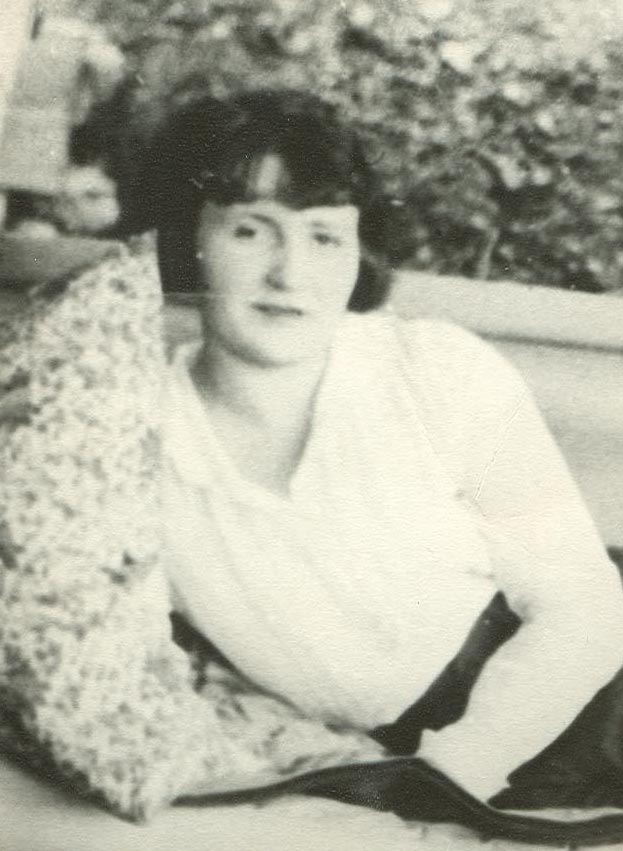
And the best part? We’ve since connected with many of their descendants, one of whom gave me a lovely picture of one of those cousins . . . and her name is also Nora.

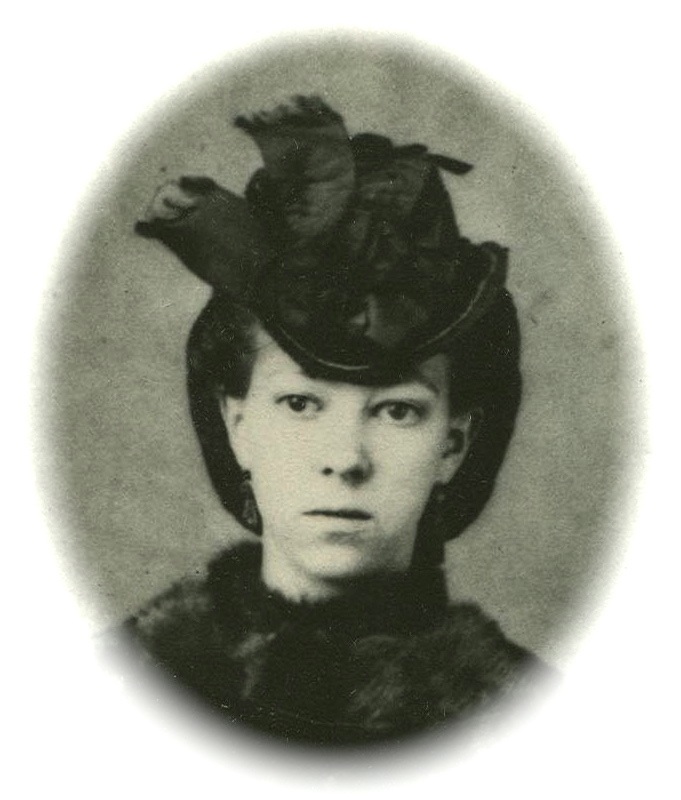
Is it just me? Or do you also think these two cousins look like they could be sisters?

I can’t help but wonder what their grandmother Nora looked like.